
Dinesh Trivedi's success or failure in this fragile diplomatic equilibrium will have consequences extending well beyond the Indian high commission in Dhaka. It will shape India's eastern strategic environment for years to come.

The Supreme Court has agreed to hear a plea from Uttar Pradesh police challenging a Bombay High Court ruling that absolved BrahMos Aerospace engineer Nishant Agarwal of major espionage charges under the Official Secrets Act. Agarwal was previously sentenced to life imprisonment by a Nagpur district court for spying for Pakistan's ISI, despite the High Court finding he only illegally stored sensitive data.

India is increasingly focusing on long-range weapons capable of reaching targets across China.

A new report from the Stockholm International Peace Research Institute (SIPRI) indicates that India has expanded its nuclear arsenal and is developing long-range weapons capable of reaching targets across China, while also maintaining focus on its rivalry with Pakistan.

India is navigating a complex diplomatic landscape, attempting to balance its 'forever honeymoon' with the Israel-UAE-Bahrain axis against its historical ties with Iran, as evidenced by recent high-level visits and evolving geopolitical realignments in the Middle East, observes Ambassador M K Bhadrakumar.
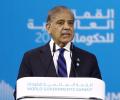
Pakistan Prime Minister Shehbaz Sharif said on Tuesday that his country respects Russia's relations with India, as he called for strengthening Islamabad's ties with Moscow during his talks with Russian President Vladimir Putin in Beijing.
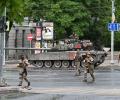
The Centre informed the Supreme Court that ten Indians have died while fighting alongside Russian forces in the Russia-Ukraine war. The court is hearing a plea seeking the repatriation of Indians allegedly forced to fight.

Russian President Vladimir Putin and Chinese President Xi Jinping have reaffirmed their commitment to dismantling global hegemonism and building a 'multipolar world' during high-level talks in Beijing.
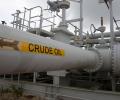
The Kremlin states it has not received confirmation from India regarding a halt to Russian oil purchases, following claims made by former US President Donald Trump. Russia affirms its commitment to strengthening relations with India.
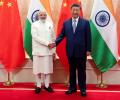
Chinese Foreign Minister Wang Yi has called on India and China to view each other as partners rather than rivals, emphasising the importance of cooperation for regional stability and development.

The reopening of the Strait of Hormuz, following a ceasefire agreement between the US and Iran, is expected to significantly ease India's crude oil supply risks, lower freight costs, and reduce inflationary pressures, as global oil prices have already dropped.

Prime Minister Narendra Modi and US President Donald Trump are set to hold comprehensive talks focusing on a bilateral trade deal, defence cooperation, and energy and critical minerals sectors during the G7 summit in Evian-les-Bains, France.
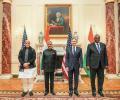
The pressure on India to take a hostile attitude towards Russia and China was not subtle, but it was guarded, observes Ambassador T P Sreenivasan after Monday's 2+2 ministerial meeting in Washington, DC.

The Indian government has addressed Parliament regarding a case of an Indian national seeking repatriation from Russia due to the situation in West Asia and the Gulf region. The government also responded to queries about Indian nationals denied entry to South Korea and seafarers detained in foreign countries.

The question nobody seems to ask is why a democracy should be silent when many of its citizens are concerned about the way the US is deviating from its traditional ways of consultation, cooperation and collaboration and moving away from traditional allies, asks Ambassador T P Sreenivasan.

Putin's State visit will centre on fixing the huge India-Russia trade imbalance, with both sides pushing to lower duties, ease non-tariff barriers, and seal a landmark mobility pact to send more Indian workers to Russia.

Delhi must now purge the delusional hopes of being a 'counterweight' to China in the US calculus, argues Ambassador M K Bhadrakumar.

The US-China rapprochement, however tenuous, is not without implications for India. Both China and Pakistan have become closer to the US, notes Ambassador T P Sreenivasan.
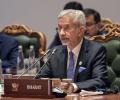
India has expressed serious concerns about the West Asia crisis and its potential impact on energy supplies and maritime stability, urging BRICS nations to find practical solutions to geopolitical challenges and unilateral sanctions.

An Indian Army contingent, Navy warships INS Tarkash and INS Ikshak, and a naval band are participating in Seychelles' Golden Jubilee National Day celebrations. Prime Minister Narendra Modi is attending as the Guest of Honour, underscoring the strong strategic partnership and defence cooperation between India and the archipelago nation.

The Kremlin has stated that India is free to purchase oil from any country, dismissing claims that India agreed to reduce Russian oil imports. Russia maintains that energy trade with India benefits both nations and contributes to international energy market stability.

Iranian Foreign Minister Abbas Araghchi is in India for a BRICS foreign ministers' meeting, where discussions will focus on the escalating crisis in West Asia and its impact on global energy supply chains.
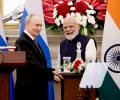
Russia, being bogged down by the Ukraine war and prioritising the requirements of its own armed forces, along with India's consistent diversification policy, will remain a major challenge to the bilateral partnership, note Harsh V Pant and Aleksei Zakharov.

India emerged reasonably well from 2025. But now, the oil shock and war-related supply disruptions have again driven funds out of India and significantly weakened the rupee, points out Ajay Chhibber.

Much will depend on how the protagonists use the current interlude to work proactively for the beginning of a durable settlement or, on the contrary, prepare for a new round of escalation, points out Ambassador M K Bhadrakumar.

Prime Minister Narendra Modi and US President Donald Trump exchanged pleasantries and held a brief conversation at the G7 summit, their first in-person encounter in 16 months, setting the stage for high-stakes bilateral talks amidst continuing strain in India-US relations.

Iranian Deputy Foreign Minister Kazem Gharibabadi has urged India to take the lead in bringing peace to West Asia, highlighting the UAE's role in stalling BRICS consensus on the conflict. Gharibabadi also discussed a new framework with Oman for merchant vessels passing through the Strait of Hormuz.

India is among six countries on the priority watch list in a US report addressing the protection and enforcement of intellectual property rights.

National Security Advisor Ajit Doval called for decisive action against terrorism and said there cannot be 'double standards' in the fight against it, while addressing an international security forum in Russia.

Lavrov's comments came two days after Russia accused the US of attempting to prevent India and other countries from buying Russian oil, saying Washington was using a wide range of 'coercive' measures, including tariffs, sanctions and direct prohibitions.

India bought 1.87 million barrels of Russian oil per day in May so far, meeting approximately 40 per cent of its oil imports.

India will maintain multiple sources for crude oil purchases and diversify them to ensure stability in the supply chain with national interests remaining the "guiding factor" for the procurement, Foreign Secretary Vikram Misri said.

External Affairs Minister S Jaishankar discussed the West Asia conflict and its impact on energy supplies with his Russian counterpart Sergey Lavrov and EU's Foreign Policy chief Kaja Kallas.
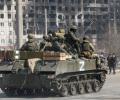
The Centre has informed the Supreme Court that 217 Indian nationals reportedly joined the Russian armed forces, with 49 fatalities amid the Russia-Ukraine war, and efforts are underway to repatriate those who were misled.

Defence Minister Rajnath Singh met his Chinese counterpart Admiral Dong Jun in Bishkek to discuss maintaining peace and tranquility along the Line of Actual Control (LAC) and broader regional security concerns.

Russia's State Duma ratified a key military pact with India, the Reciprocal Exchange of Logistic Support (RELOS), ahead of President Vladimir Putin's visit to New Delhi. The agreement facilitates mutual logistical support between the two countries' military forces during exercises, training, and disaster relief efforts.

Prime Minister Narendra Modi's visit to Italy concluded with the elevation of India-Italy relations to a Special Strategic Partnership, focusing on enhanced cooperation across various sectors.

The Petroleum Planning and Analysis Cell (PPAC) has denied an RTI request for data on oil imports from Russia, citing its 'commercial and confidential' nature and exemptions under the RTI Act. The Central Information Commission supported this decision, referencing strategic and economic interests.

India and Russia are expected to sign a bilateral mobility agreement during President Vladimir Putin's visit to New Delhi, establishing a framework for legal migration, worker protection, and expansion of skilled Indian manpower in Russia.
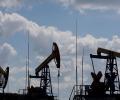
Two days after Russian President Vladimir Putin concluded his visit to India, during which he assured that Moscow would remain a reliable energy supplier, the Kremlin on Monday said that India, as a sovereign nation, is free to buy oil from sources it deems beneficial. It expressed confidence that New Delhi will continue to prioritise its economic interests.
